
I was honored to be asked to present a special lecture at the University of Ghana’s Departments of History and Political Science. I was asked to speak about the relevance of history in the public sphere and used this opportunity to present parts of my newest book, Making an African City: Technopolitics and the Infrastructure of Everyday Life in Colonial Accra (Indiana University Press, 2024), and to reflect on the challenges presented by the recent Accra floods. Here’s what I said:
State, People and Cities in Africa: Why History Matters in Addressing Present and Future Challenges
Good morning
Let me begin by thanking Head of the Department of History Prof. Cyrelene Amoah-Boampong, Head of the Department of Political Science Prof. Isaac Owusu Mensah, Dean of the School of Arts, Prof. Wazi Apoh, and Director of the Institute of African Studies, Prof. Samuel Ntewusu for the invitation to speak today and Dr. Danladi Abah and his student David for so ably and generously arranging this opportunity. It is a genuine privilege to be here. I came to Legon more than 20 years ago as an undergraduate student interested in the role of Christian churches in development in Ghana. I lived in ISH when it was the farthest point of the campus and took classes in Tingi Tingi and ate at the bush canteen and walked through what was then bush from the nightmarket to okpongalo to catch trotros into Madina to shop at the market or, occasionally, into Osu for a special night out. I traveled all over Ghana and I took courses in Philosophy, Religion, History, Political Science, Sociology, and Twi which expanded my understanding of myself and the world and remain very much foundational to the work that I do. I am so incredibly grateful for my experience, and it has been absolutely foundational to who I am as a scholar and a person. And I have some great stories about professors! Over the years I’ve come back to live at Commonwealth and study Twi with Kofi Agyekum, developed deep and abiding friendships with people across campus including my compatriot Samuel Ntewusu who has long been my partner in transport history and the members of the Ghana Dance Ensemble who have long been like family, and I have seen how much things have changed. Including our gray hair – mine more than Ntewusu’s. Legon is simultaneously the same and totally different. I get lost! And there’s lots of new faculty and students around, of course. It makes me feel a little bit old, and I’m getting a bit sentimental in my old age. Because when I stand outside of the Institute of African Studies and look at the main gate and Tingi Tingi and the old institute building and Akuafo Hall, I still feel very much at home and feels like it was all only yesterday. It’s an honor to be here and to be in conversation with you today. It truly means a lot.

Over the last twenty years, I have spent a great deal of time thinking about Accra. Much of that time has been spent in archives—working through municipal correspondence, engineering reports, sanitary records, newspapers, maps, and government files – and collecting oral histories and engaging in ethnographic research in the lorry parks, markets, and streets of the city, both in areas like Pig Farm, Kotobabi Down, and Agbogbobloshie and in the old Ga quarters of Osu, Jamestown, Usshertown, La, Teshie, and Nungua. When people ask what I study, I usually tell them that I study mobility, technology, infrastructure, and urban space in 20th century Ghana. I’ve written books and articles and created digital projects about the history of motor transportation and the history of infrastructure and urban development. That answer is accurate, as far as it goes, but it is rarely the answer people are really looking for. What they usually want to know is a much more practical question. Why does any of this matter?
It’s a fair question. Historians don’t always answer it particularly well. We often assume that the importance of history is self-evident. We say that history helps us understand the present. Or we repeat Santayana’s famous observation that those who cannot remember the past are condemned to repeat it – or a similar sentiment from Churchill that “Those who fail to learn from history are doomed to repeat it”. Here in Ghana, we might invoke the idea of Sankofa—that “it is not taboo to go back and get what you have forgotten or left behind” (I won’t subject you to my Twi pronunciations).

There is wisdom in all of those observations. But over the last few years I’ve become increasingly convinced that they don’t quite capture what historians actually do. That was most clear in the classroom. Every year, on the first day of class, I ask my students a simple question: What is history? The answers are remarkably consistent. Most tell me that history is the study of the past. A few say it helps us avoid repeating mistakes. Others describe it as a record of important events or the story of where we came from. None of those answers is wrong, per se. But by the end of the semester, I hope they’ve begun to think about the question a little differently. History, they discover, is not simply the study of the past. It is a discipline. A method. A way of asking questions.
Historians spend a surprising amount of time asking rather awkward questions. We ask where particular ideas came from. We ask why institutions developed in the ways they did. We ask why some explanations become accepted while others disappear. We are trained to be suspicious of things that appear obvious. We are interested in categories that seem natural, institutions that seem inevitable, and assumptions that have become so familiar that nobody notices them anymore. And perhaps most importantly, we are trained to follow the evidence wherever it leads. Even when it’s challenging or inconvenient.
For my most recent book (which I do not have hard copies of unfortunately but which can be read free online on the Indiana University Press website through this QR code), I spent an extraordinary amount of time reading about refuse boxes, mosquitoes, drainage inspections, nuisance ordinances, market regulations, and property assessments. I knew what I was in for. I had read and used the minutes of the Accra Town Council, located at the British National Archives in Kew, for my first book but I was eager to return to them because they seemed like an unusually rich and complex record that provided unique sorts of insights into the unfolding and contested nature of urban governance in colonial Accra. Yes, as John Parker argues, European architectural and infrastructural logics did increasingly shape the built environment of the city and the foundations of legal authority, and the power to regulate did increasingly sit in the hands of British officials rather than Ga leaders by the early 20th century. But even as the British worked to remake Accra into an ideal capital for its “model colony”, Accra residents asserted their own visions of the city and demanded that new technologies and investments reflect their own interests, not just those of expatriate capital.

The files filled with debates about refuse boxes and mosquitoes and drainage inspections and nuisance ordinances and market regulations and property assessments highlighted that, while the physical city mattered – roads mattered, drainage mattered, markets mattered – what seemed to occupy colonial officials and African residents just as much were the rules governing those things – how refuse should be collected, how buildings should be inspected, how markets should be regulated, who should pay rates, which neighborhoods deserved investment, and who had the authority to make those decisions. The point was not the roads and drains themselves, but rather the systems that governed everyday urban life.
That observation eventually became the starting point for Making an African City and it reflects my enduring fascination with the everyday and the ordinary. I was fortunate to visit Nubuke last week to view their current group exhibition, “Weight of the Ordinary”. I love Nubuke and this exhibit was a wonderful reason why. The curatorial statement at the beginning put to words so much of what I think makes the ordinary important:
“… the ordinary is neither passive nor insignificant. It is where histories persist, identities are formed, systems operate, and futures are imagined. …The exhibition asks not what lies beyond ordinary experience, but what becomes visible when we take its weight seriously.”
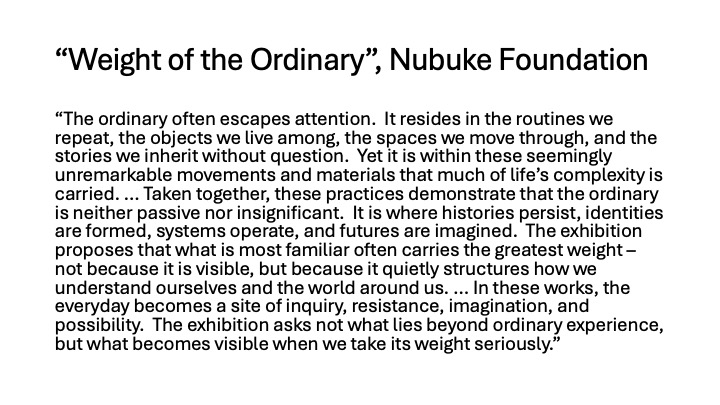
It’s such a powerful statement. Everyone should go see the exhibit and spend time at Nubuke. But what this says so powerfully is that the ordinary is where the political is lived and experienced. As Filip de Boeck argues, mundane infrastructures are the “built forms around which publics thicken” – people engage in politics through these everyday, ordinary objects and systems. That’s what the book is about – the tension between policy and practice, ideology and the everyday and the way that it plays out uniquely in urban space.

But this morning is not really about the book. It is about something larger. It is about what historians do. More specifically, it is about what historical thinking contributes to the way we understand African cities and the challenges they face today.
That question became unexpectedly immediate for me and maybe many of you in new ways just a few weeks ago. I arrived in Accra on the 28th of June. The following morning, heavy rains led to flooding across large parts of the city. Over the days that followed I listened to conversations on the radio, read newspaper editorials, spoke with friends and colleagues, and heard remarkably thoughtful debates about drainage, planning, infrastructure, governance, climate change, and responsibility. Some people blamed government. Others blamed citizens. Some pointed to blocked drains. Others to rapid urbanisation. Still others to changing weather patterns. None of those explanations struck me as unreasonable. But as I listened, I found myself asking a rather different set of questions. How did these systems of drainage come to exist in the first place? Why do similar debates recur generation after generation? Why are some solutions easy to imagine while others seem almost impossible to articulate? Those are historical questions. They don’t produce simple answers. History rarely does. But they do change the conversation.
That, I think, is one of the most valuable things historians contribute. Not because we possess better solutions than engineers, planners, political scientists, economists, or environmental scientists. We don’t. But because we ask different questions. In deploying key historical thinking skills – periodization, historical context, contingency, cause and effect, agency and structure, continuity and change – we generate precise questions that help us untangle the complexity in front of us, grounding our frustrations and anxieties and ideologies in evidence that is hard to deny. This morning I’d like to suggest that one of the best places to see the value of those questions is in the relationship between three ideas: the state, the people, and the city. How did states seek to govern African cities? How did people respond, negotiate, resist, and reshape those efforts? And how did those relationships produce the cities we have inherited today? Those are historical questions. They also happen to be some of the most important questions we can ask if we hope to imagine the future of African cities. Or if we hope to understand and address issues like persistent flooding in Accra.
Today, then, I just want to draw on a few examples of these histories in Accra to illustrate what I’m talking about and then spend a little time thinking about what all of this means.

One of the documents that kept drawing me back was a short editorial published in the Gold Coast Leader in January 1909. It was complaining about rubbish.
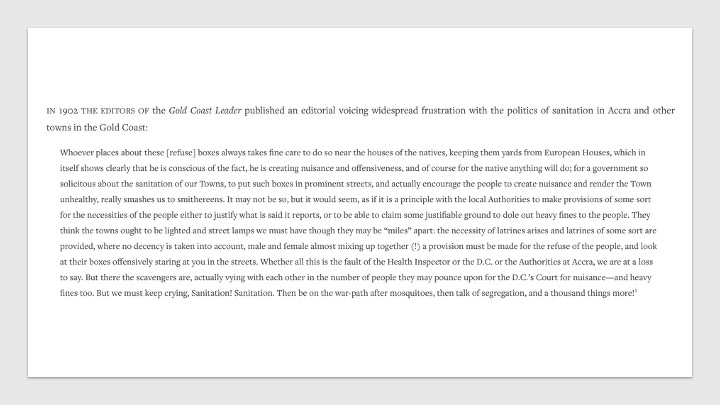
The editors began with an observation that was at once funny and deeply pointed:
“Whoever places about these refuse boxes always takes fine care to do so near the houses of the natives.”
This is the voice of someone who has become exasperated with municipal government.
It continued:
“The places where they are deposited are generally selected without the least regard for the comfort or convenience of the people living in the neighbourhood.”
And then came the really important question:
“Why should these refuse boxes always be placed near native houses?”
At first glance, this looks like a complaint about sanitation.
In one sense, of course, it is. But the editors were also asking a much bigger set of questions: Who decides where public services are located? Whose comfort matters? Whose neighbourhoods receive investment? Who gets consulted? Who bears the costs of decisions made in the name of the public good? Those are not simply questions about refuse collection. They are questions about governance – about how the state works.
The editors refused to accept the idea that sanitation was merely a technical matter. They understood instinctively that something as mundane as the location of a refuse box reflected larger assumptions about how the city should be governed and whose interests that governance was meant to serve. These are not questions about infrastructure as a physical object but rather about the systems that organized everyday urban life. Roads and drains and refuse bins are more than mere things. They create relationships between governments and the people who lived with them.
This is not to say that the physical city was unimportant. Roads, drains, markets and water supplies mattered enormously. But colonial officials seemed just as concerned with governing through infrastructure as with building it. Behind every apparently technical decision lay a series of choices that were never technical alone: Where should investment be directed? Which neighbourhoods required attention? What constituted a “proper” town? Who possessed the authority to decide? Those were political questions, even when they were expressed in the language of engineering or sanitation.
Once you start to notice them in the archive, you will start seeing them everywhere – refuse boxes, nuisance ordinances, building inspections, property assessments, mosquitoes. The municipal records seemed endlessly preoccupied with things that appeared, at least initially, rather ordinary. This was the boring but critically important making of the world through the mundane politics of everyday life. They were the everyday practices through which relationships between the colonial state and the residents of Accra were continually negotiated. The history of infrastructure, in other words, is also a history of governance. And perhaps a history of capitalism.
The British colonial state used sanitation, in particular, as a justification to extend legal authority over land, beginning with the 1876 Public Lands Ordinance, extended in the 1892 Towns Ordinance, and culminating in the 1894 Town Councils Ordinance. This series of legislation gave the British unprecedented control over urban lands in the name of a newly but vaguely defined “public interest”, increasingly associated with sanitary policy. Sanitation was the foundation of a new category of “public nuisances” – an expansive list that included:
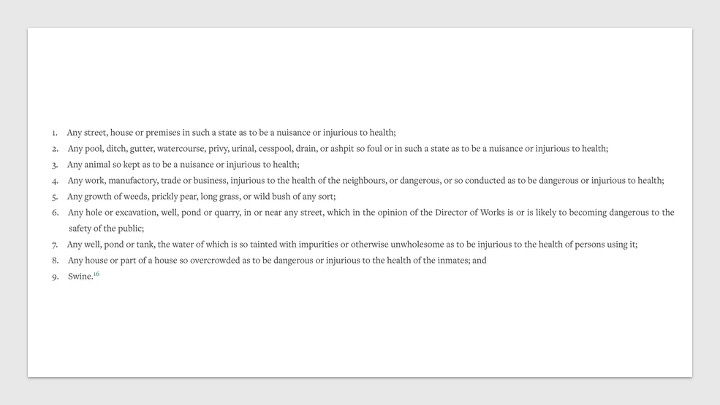
The implications of this new category of “public nuisance” touched many areas of daily life in cities like Accra, and in marking off particular spaces or practices as “nuisances”, these new laws allowed the state, through newly appointed sanitary inspectors and backed by the power of the courts, to intervene in private African spaces and prosecute offenders. As representatives of the government, these sanitary inspectors had unprecedented authority over both the public spaces of shops, warehouses, manufacturing sites, and workshops as well as the private spaces of households and compounds.
If the Public Lands Ordinance gave the government the right to shape the physical space of the town and the Towns Ordinance created new systems of sanitation and oversight in the public and private spaces of residents, the 1894 Town Councils Ordinance created new political structures that devolved responsibility for the implementation of sanitary guidelines. In creating a new institution of local government that had at least some elected representatives chosen by newly designated ratepayers, the Ordinance sidestepped chiefs who, under indirect rule, held responsibility for local governance, and empowered a new class of urban residents who were identified solely based on their connection to private property ownership. Town Councillors – half “official” (i.e. appointed by the Governor) and the other half “unofficial” (i.e. elected) – and an appointed President (the District Commissioner) and his Town Clerk were responsible for overseeing the improvement and maintenance of the town and collecting property taxes (or rates). While expectations of improvement were left undefined and subject to revision over time, the Council’s sanitary responsibilities were explicitly laid out in the Ordinance:
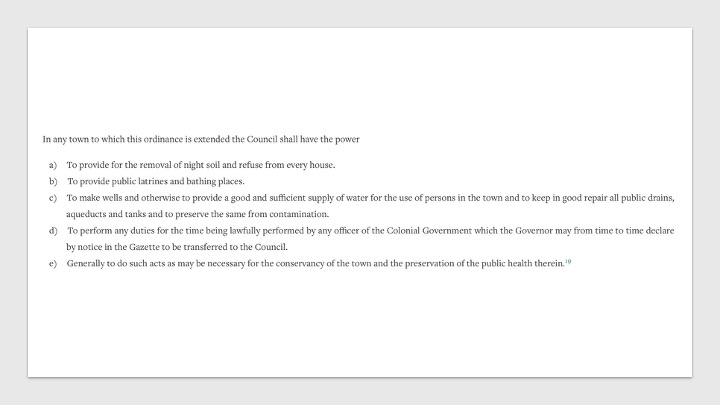

This shift in the 1894 Town Councils Ordinance was significant. On the surface, it seemed really positive – a form of proto-self-government in which the town was maintained through the collection of taxes (in this case property taxes or “rates”). Ratepayers elected their own representatives who, while not in the majority on the Town Council, still held a significant number of seats and presumably had some degree of influence over the operation of the Council and its use of the collected funds. For British colonial officials, this system was ideal because it was self-sustaining. By collecting their own revenue, the Accra Town Council (which was the first and largest) would no longer have to rely on funding from the central government. Town maintenance was a town affair and the responsibility of town residents and their representatives.
In reality, the system of taxation and representation served as justification for systemic underinvestment in ways that shifted responsibility – often unjustly – on to African residents. Regulations – sanitary or otherwise – passed by the Legislative Assembly or even the Town Council became unfunded mandates without necessary investment. As protests from ratepayers in the decade after the passage of the Town Councils Ordinance highlighted, few in Accra could still afford to pay high rates on properties that they or their families had built fifty years before. Chiefs lost income due to changes in court structures that limited their ability to collect fines. Merchants lost income when they were pushed out of the import/export trade by European firms who increasingly consolidated power over the movement of goods along the coast. And professionals like doctors and lawyers found their opportunities increasingly circumscribed as the British government banned Africans from most higher-ranking roles in colonial government and social services. While Accra had many fine houses, the people living in those houses found it increasingly difficult to maintain them or pay their taxes.
The system of rate-paying also failed to account for the large numbers of people living in the city who did not live in rate-able properties – individuals who were living in rented single rooms, traditional wattle and daub buildings, or small shacks but who nonetheless needed access to basic infrastructure like water, sanitation, and roads. Few houses had private latrines or pipe-borne water. Residents noticed and made their displeasure known. As “Pexbroke Playfair” wrote to the editors of The Gold Coast Independent in 1922,
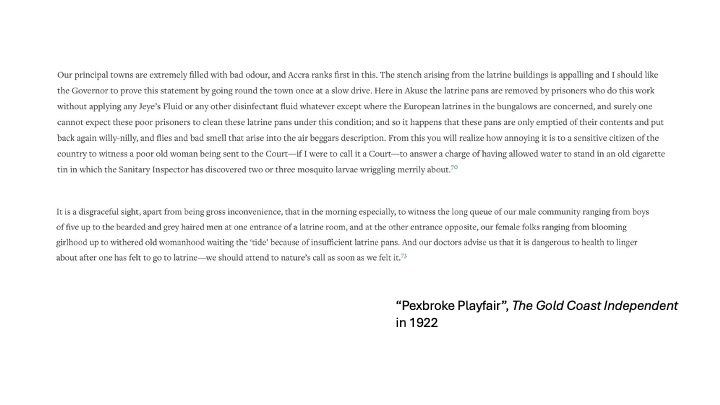
In writing under the pseudonym Playfair, this resident exemplified a broader public discourse that connected the indignities of sanitary smell and the condition of latrines with questions about the Town Council’s legitimacy and effectiveness. Throughout the first several decades of the 20th century, African politicians and residents regularly pointed to the Town Council’s sanitary failures – evidenced by the physical and sensational experiences of the city – as justification for abolishing the Town Council altogether. If the Town Council did not have sufficient funds to fulfill their primary responsibility – sanitation for the town – then why were they paying taxes? Where was that money going? Critics frequently pointed to the large number of highly paid European employees and sanitary inspectors who spent the bulk of their time conducting home inspections and dragging residents to court for minor violations of sanitary laws. These fines generated yet more revenue for the Town Council. In the absence of significant infrastructural improvements and education, sanitary regulations appeared to be nothing more than yet another mechanism to extract revenue from residents. These inspections particularly targeted women who generally did not pay taxes as property owners. In questioning the fiscal responsibility of the Council and the effectiveness of its regulations, residents directly challenged colonial constructions of the “public good.” As Playfair noted,
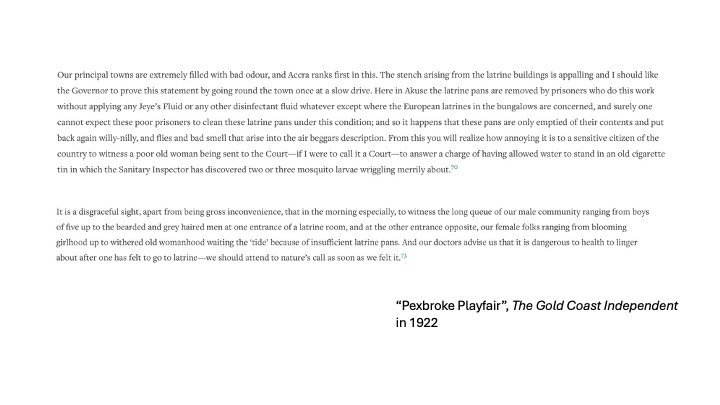
This persistent lack of investment in town infrastructure – forcing men and women, often of the same household, to use the same latrine building with inadequate partitions (often nothing more than a partial swish wall or a piece of corrugated iron) – was an indignity that violated both Ga social and cultural norms as well as European expectations of gendered propriety. This sort of construction-driven social indignity was a more subtle form of much older infrastructural danger, produced through active disinvestment in African sanitary infrastructure that dated back to 1896:
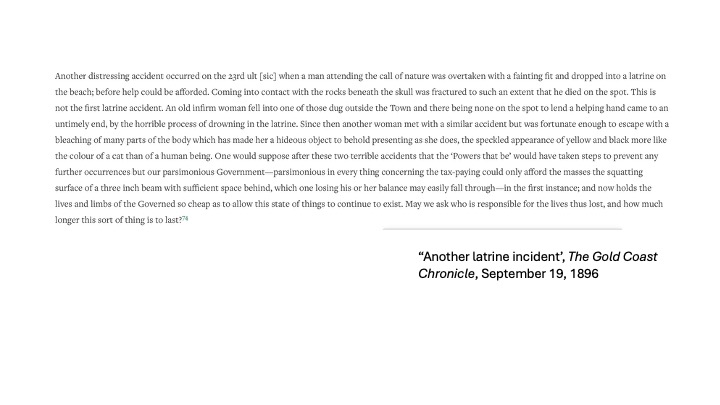
Sanitary investment (or disinvestment), at the expense of human life and general wellbeing, seemed to contradict the espoused goals of sanitary regulation. The smells and dangers of latrines were compounded by that of dustbins, placed around town for the disposal of rubbish, which “aside from their evil effect on the public health, they are unsightly.” Public complaints about sanitary regulations, malicious prosecution, and under-investment did little to change state practice. As one commentator noted,
“After the outbreak of Plague at Accra in 1901 and the great outcry of inefficiency of the Town Council as a Sanitary authority, it was thought that the Government would take off the mask, put a stop to the pretext of teaching the people self-government, take matters into their own hands, and abolish the Town Council. But this was not done. The same old jugglery goes on, and with the trump cards in the hands of the Government, the game of fooling and bamboozling the native continues as merrily as ever.”
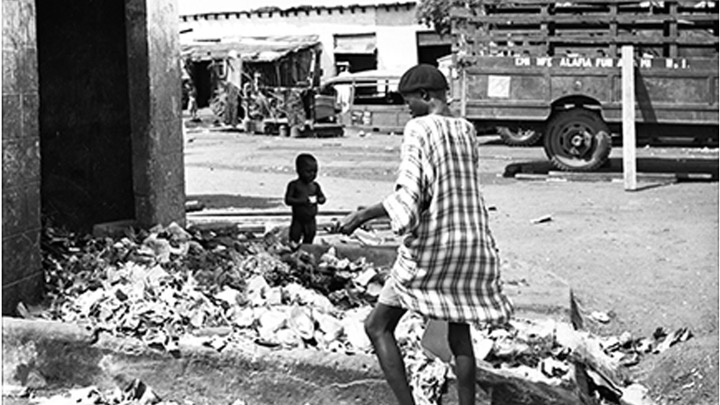
Particularly in the cramped quarters of the old town, demand clearly exceeded the infrastructural capacity of the city’s sanitation system. In 1933, the most populous parts of the city, including James Town and Asere, had as many as 67 people/pan; other areas had 37 people/pan. Newly developed parts of the town were disadvantaged in different ways. Councilor Kojo Thompson noted in 1934 that there were only two public latrines to serve the entire community of Adabraka. If the latrine system needed to be doubled in 1912 “in order to secure any approach to efficiency”, the lack of sustained investment in expanding the city’s waste removal system over the decades that followed meant that by 1942 the town’s 78,000 residents used public latrines that were “thronged with ever-increasing crowds of people” and the Council maintained a fleet of conservancy lorries that were “continuously employed in emptying the pans.” The daily influx of people from surrounding districts into Accra – particularly around commercial districts and markets – meant that some latrines were emptied two or more times per day, a practice that would have to continue until more public latrines were constructed or the sewage system was otherwise improved. These same densely settled communities, however, afforded little space for the construction of additional public facilities.

Incompleteness of colonial infrastructural systems and “make do” attitude had enormous consequences for Africans, even when they did embrace new systems like sewerage or sanitation. British officials engaged in a simultaneous fetishization of waste and unwillingness to invest in waste removal – a symptom of much more deeply-rooted colonial expectations for African cities like Accra as timeless and inherently diseased and decaying. Official debates about whether Africans could responsibly operate flushing latrines without waste and calls for water regulators and official latrine operators highlighted the degree to which these assumptions were not just spatial but mapped onto the bodies of town residents. Public health officials often blamed this toxicity on “misuse or a pathological form of African urbanization” when in reality it was “an austere colonial technology working as designed.”
Similar patterns play out in relation to roads and drains. Between 1913 and 1930, when there was excess revenue from an economic boom, the government engaged in a consistent program of constructing main and subsidiary surface drains and making up new roads in Accra. Roads connected the town to other centers of trade, particularly in the cocoa growing regions that lay to the north and east. But road construction also played a central role in the modernization of the town as a colonial capital and commercial hub. While much of the early investment was made in areas of concentrated European settlement or governmental and commercial activity, road construction was also part of broader plans to decongest the city center and lay out new neighborhoods for African residents across the socioeconomic spectrum. In the early 1920s, the Public Works Department introduced tarmet road construction to Accra, which produced more durable road surfaces, along with extensive road drainage systems. These new investments simultaneously created more reliable infrastructure and greater responsibility for maintenance and upkeep. With the global depression in 1929, however, revenue-fueled infrastructural development collapsed just as quickly as it had grown. The regular program of road construction, drainage, and maintenance was shut down in 1930 due to a shortage of funds. In the estimates for 1932-33, the Director of Public Works acknowledged that increased traffic and delayed maintenance meant that “the entire reconstruction of some of the most highly trafficked streets must be undertaken at an early date.” However, decreased revenue meant that large-scale reconstruction was now impossible. He focused instead on a small section of road in the elite neighborhood of Christiansborg.
While the Town Council was not directly responsible for road construction, these financial decisions had implications for the Council’s work. As early as 1930, Councilor de Graft Johnson noted “the deplorable condition of some of the main streets and roads in Accra” and called for the redirection of funds from the “less important” Labadi-Teshi Road to the roads in Accra itself. The Acting Senior Public Health Engineer noted that the construction of roads and drains was the responsibility of the Government, but he suggested that the Council should forward proposals and suggestions for town roads for consideration. Early Town Council action focused on areas in middle class African neighborhoods where councilors had direct experience and investment. The dedication and persistence with which Town Councilors pursued improvements for Boundary and Castle Roads were certainly influenced by their personal connections to the dangers and inconveniences of undrained, unfinished roads. As elite and powerful property owners, African councilors could afford to give up land for road development and they had access to power which allowed them to agitate for action. While their privilege generated more attention for the condition of Boundary Road, it did not necessarily produce results. In 1931, the Director of Public Works expressed his sympathies for the Council’s position, but reported that all financial provision for surface water drainage had been cut out of the estimates as part of austerity measures. The situation did not improve in the following year. There was no provision made for roads in the estimates. This pattern was repeated throughout the 1930s – complaints about the conditions of roads, studies to inform comprehensive plans for improvement, followed by limited or no investment. Even when people followed town plans, there was no guarantee that infrastructure would actually follow. Colonial officials used technicalities of categorization to pass off responsibility to the Town Council, which could not afford the work. Residents could not reach their homes or use their motor vehicles, their houses flooded in heavy rains, and they risked illness and injury on the streets of the town.
Sanitary infrastructures certainly generated new forms of debate about the purpose and responsibility of the state, the meaning of representation and self-governance, and the visions for urban governance and city life in Accra. This was in part by design; urban governance was, in the minds of British colonial officials, both a means to achieve sanitary goals and a way to decentralize or devolve responsibility for the construction and maintenance of the town onto African residents. Accra municipal government was formed as and remained a sanitary state throughout the first half of the 20thcentury. Municipal revenue funded the salaries of sanitary inspectors, engineers, and other public health officials. However, sanitary politics also highlighted the persistent ambiguities of colonial rule.
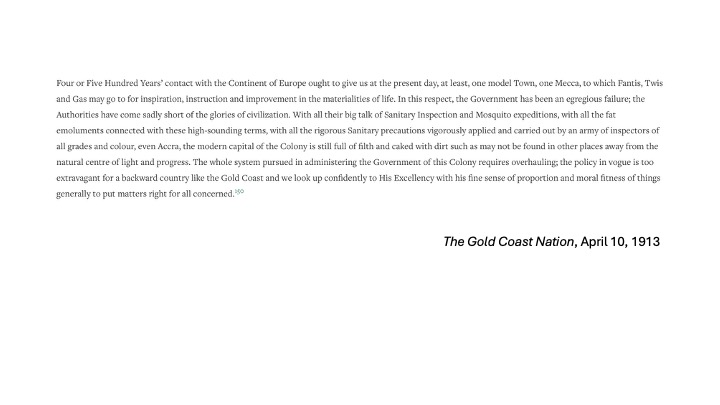
In creating and maintaining incoherent, inconsistent, unreliable, and often overlapping structures of authority in the town, colonial officials often blurred boundaries of responsibility and complicated the organization of town affairs. In part, as many town residents argued, this confusion evidenced a broad-based incompetence within the colonial administration, exacerbated by constantly changing personnel. For African contemporaries and present-day scholars alike, this incompetence highlighted the failure of a colonial state that never could realize its grandiose visions of “civilization” in model towns like Accra. As one (possibly sarcastic) writer argued
For some, this was a question of responsibility. Having extracted taxes and other forms of wealth from the colony for many years, these residents argued that the British administration should be financially responsible for constructing infrastructure in the town before it attempted to hand over maintenance and governance to local authorities. For still others, inadequate sanitary infrastructure and persistent under-investment in African quarters of the town evinced an underlying infrastructural segregation, driven by underdevelopment, through which European residents were the primary beneficiaries of investment drawn from African taxation. In refusing to productively and proactively respond to public complaints, Town Council leaders and British officials transformed infrastructural questions into a debate about African rights to the city and its resources, in which the use of infrastructure itself was a potential violation that required regulation, policing, and punishment. In some cases, that meant resisting government plans altogether, including protests against excessive prosecution, taxation, and fines. More often, however, residents protested to increase access to infrastructure and more evenly distribute investment in the colonial capital. As one resident complained in 1900:
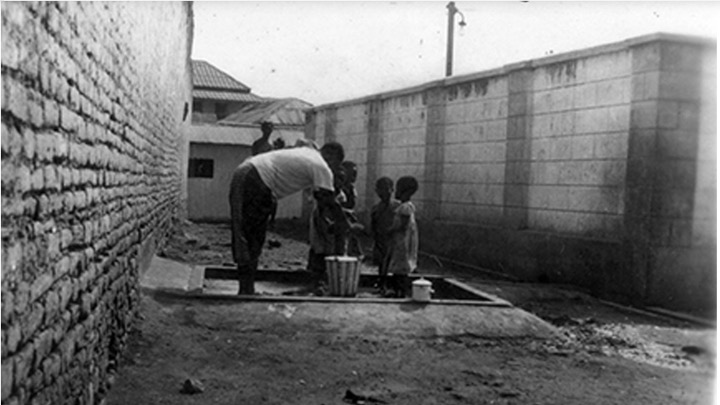
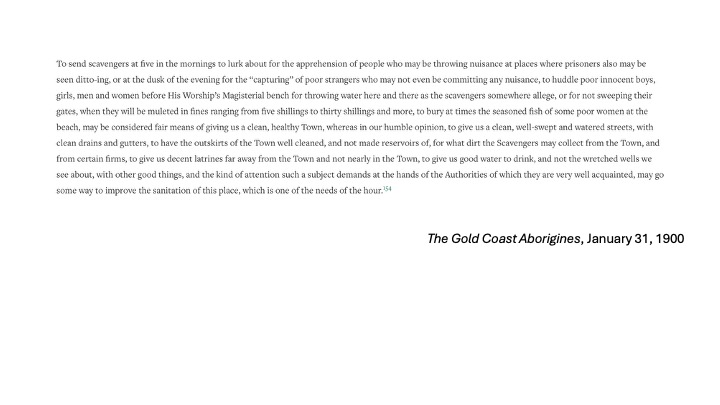
Even as the state began to increase investments in the 1930s and 1940s, it was increasingly clear that state power lay not in big infrastructural projects or in their ability to physically remake the town but rather in the power and willingness to regulate and prosecute. In policing and prosecuting African behavior in both public and private spaces, the Town Council and other regulatory bodies consistently placed responsibility for the unsanitary state of the town on African residents. Backed by the power of the police and the courts, the regulation and enforcement of sanitary measures marginalized and criminalized African behaviors and bodies in new ways and enshrined new forms of state authority over both public and private space while investing little in actual physical infrastructure and maintenance.

Nothing happened to address any of these infrastructural issues until the earthquake in 1939. For colonial officials, this was a useful crisis, which allowed them to remake the city. Infrastructural investment, in other words, was not about providing resources for the people. It was about imposing a vision of city life on a space. Governor Arnold Hodson’s correspondence is revealing in this regard. Within days of the disaster Governor Arnold Hodson was already thinking beyond emergency relief. The destruction, he suggested, created an opportunity to rebuild Accra into “a town which everyone will be proud of.” For Hodson, the earthquake opened a space in which long-discussed colonial planning schemes might finally be implemented. Roads could be realigned. Congested neighbourhoods could be cleared. Building standards could be enforced. The city could become healthier, safer, and, in the language of the period, more modern. For many residents, the more immediate questions were practical. How quickly could homes be rebuilt? Who would pay? What would happen to family property? Would rebuilding become an excuse for new forms of intervention?
None of this is a story of simple opposition. It is a story of people confronting the same historical moment from different positions, with different experiences, and therefore imagining different futures. It is often in these moments of crisis that we see the power of classification and categorization, as well as their limits. The “informal” spaces of the city – the spaces and structures that did not meet European expectations of urban life – were also the most resilient and adaptable in the aftermath of the disaster. That’s not to over-valorize them – or the idea of resilience in the face of poverty and insecurity. But it points to the importance and power of historical questions. Because those building practices or trading practices or sanitary practices had not been “informal” before they were labeled a nuisance. Their position within the regulatory and judicial landscape of city politics and city life was not natural or inherent. It was produced. History encourages us to ask deeper questions. How did particular practices come to be described as informal in the first place? And to what end?
Moments like the earthquake – or perhaps like the recent floods in Accra – can prove unexpectedly helpful in thinking about these kinds of questions because they expose the cumulative consequences of decades of earlier decisions, and they force us to question the fundamental assumptions about “the way things are” or “the way things should be”. Housing shortages, Property disputes, Patterns of municipal investment, Planning regulations, Sanitation challenges, and flooding had histories. None of these suddenly appeared in June 1939. Or June 28, 2026.
If we pay closer attention to the historical processes through which certain practices came to be classified as formal or informal, legal or illegal, orderly or disorderly, we begin to see the city and its politics differently. That may sound like a rather academic distinction. I don’t think it is. Because the categories governments use have consequences. They shape where investment flows. They influence what kinds of housing receive public support. They determine which activities become regulated and which become criminalised. They affect whose claims to the city appear legitimate and whose do not. In other words, categories are never simply descriptive. They are part of the history we inherit.
So this brings us back, once again, to the question with which I had begun. Not what infrastructure was built. But how relationships between states, people, and cities were continually being remade through the ordinary practices of urban governance. The earthquake did not answer that question. If anything, it made it more complicated. History often does.
The city itself is best understood not as a finished product, but as an ongoing conversation between governments, experts, residents, and the countless unforeseen events that none of them fully controls. That strikes me as a rather hopeful way of thinking about cities. Because it reminds us that they have never been finished. They are always, in one way or another, still being made.

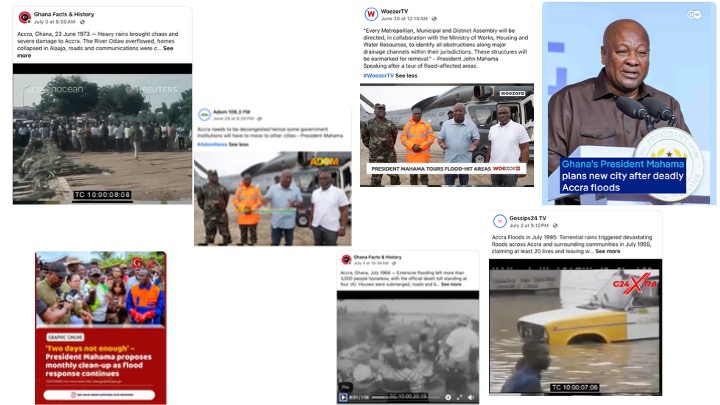
When I arrived in Accra a few weeks ago, the city was once again confronting severe flooding. History reminds us that people acted with incomplete information, that institutions produced unintended consequences, and that decisions that seemed sensible at one moment often created problems that only became visible decades later.
That is one of the reasons I find the relationship between history and public policy so interesting. History rarely tells us what to do. I don’t think it should. Historians are not engineers. We are not hydrologists. We are not architects. We are not economists. Nor should we pretend to be. The future of African cities will depend upon all of those forms of expertise. But history changes the questions we ask before we begin searching for answers. Those questions do not replace engineering or planning. They complement them. History reminds us that every technical system also has a history. Every institution has a history. Every regulation has a history. Even the questions we ask have histories.
That strikes me as particularly important in African cities because so many contemporary debates continue to rely on categories whose histories are rarely examined. Formal. Informal. Planned. Unplanned. Legal. Illegal. Modern. Traditional. These words appear so frequently that we sometimes forget to ask where they came from. Yet much of what I have tried to show this morning is that those categories were themselves historically produced. They emerged through debates about sanitation, public health, planning, engineering, taxation, and municipal government. They reflected particular understandings of how cities should function and who possessed the authority to make those decisions. Recognising that history does not tell us whether those categories remain useful. It simply reminds us that they were made. And things that were made can also be remade. The city we know today was not inevitable. The institutions we inherit were not inevitable. The categories through which we understand urban life were not inevitable. They were the products of countless human decisions, negotiations, compromises, disagreements, accidents, and unforeseen consequences. History cannot undo those decisions. Nor can it tell us exactly what decisions should be made next. But it can make us more attentive to the assumptions we carry into those decisions. That may sound like a modest contribution. I don’t think it is.
That is why, when I ask my students what history is at the end of the semester, I hope they no longer tell me that it is simply the study of the past. By the end of the semester, I hope they have become a little less certain. Not because I expect them to leave with a better definition. Historians are notoriously bad at agreeing on definitions. I hope, instead, that they have become a little more curious. A little more willing to ask where evidence comes from. A little more attentive to the assumptions that shape the questions we ask. And perhaps a little more comfortable with complexity and uncertainty. I hope they have begun to understand it as a discipline that teaches us how to think. Not by providing final answers. But by helping us ask questions that are better informed, better evidenced, and, perhaps, a little more humble.
History is not valuable because it provides us with answers. It is valuable because it teaches us how to ask and think through questions. I think that’s maybe how we imagine a better future.
Thank you.
